

Why Are the Pf7 and Pf8 Web Apps Being Deprecated?
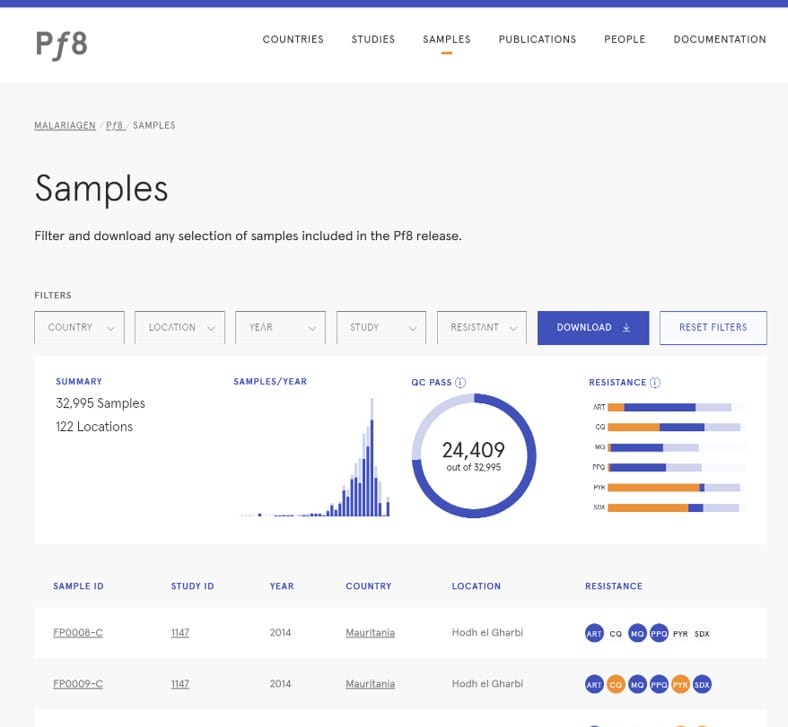
These tools were designed at a time when web-based exploration interfaces provided a major leap forward in accessibility. However, advances in data science infrastructure, cloud computing, and user expectations mean that:
- Maintenance overhead has become significant as underlying technologies age.
- Growing datasets increase the need to keep all relevant information closer to the source, promoting clarity around contributions
- User needs have evolved, with greater demand for programmable, reproducible, and integrative workflows.
Deprecating these web applications ensures that MalariaGEN can focus its efforts on meeting users’ current needs - the ability to directly access and analyse the data.
What Does Deprecation Mean in Practice?
Deprecation does not mean immediate disappearance, but we are in a transition to that point. Users should be aware that:
- The Pf7 and Pf8 web applications will no longer be actively maintained
- The tools will be fully retired and taken offline by the end of July 2026.
Importantly:
- The datasets themselves are NOT being removed
- Access to underlying data will continue through alternative platforms
Where Should Users Go Instead?
All information about MalariaGEN parasite data, how to access the data and tools to explore it is provided in the MalariaGEN parasite data user guide (MalariaGEN parasite data user guide — MalariaGEN parasite data user guide).
Looking Ahead
The deprecation of Pf7 and Pf8 web tools marks the end of an important chapter - but also the beginning of a new one.
MalariaGEN remains committed to:
- Open data access
- High-quality genomic resources
- Supporting the global malaria research and surveillance community
By investing in scalable infrastructure and more flexible data delivery, the goal is to empower users with better tools and more reproducible science.
If you have questions, the MalariaGEN team is always ready to help. Please contact support@malariagen.net


